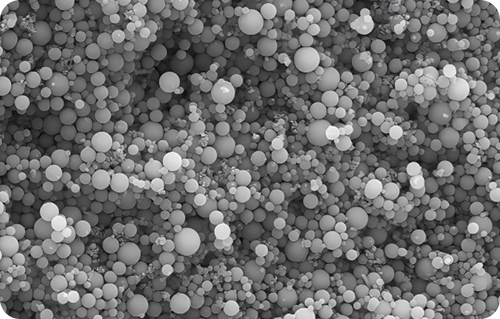


Its submicron scale significantly increases its specific surface area, leading to more contact interfaces with thermally conductive matrices (such as epoxy resin, silicone rubber, etc.), effectively reducing interfacial thermal resistance.
The spherical morphology provides optimal packing density, enabling the formation of continuous and dense thermal pathways within the matrix. This avoids thermal "breakpoints" caused by voids in the packing of irregular particles, allowing heat to be rapidly transferred along the aluminum powder particles.